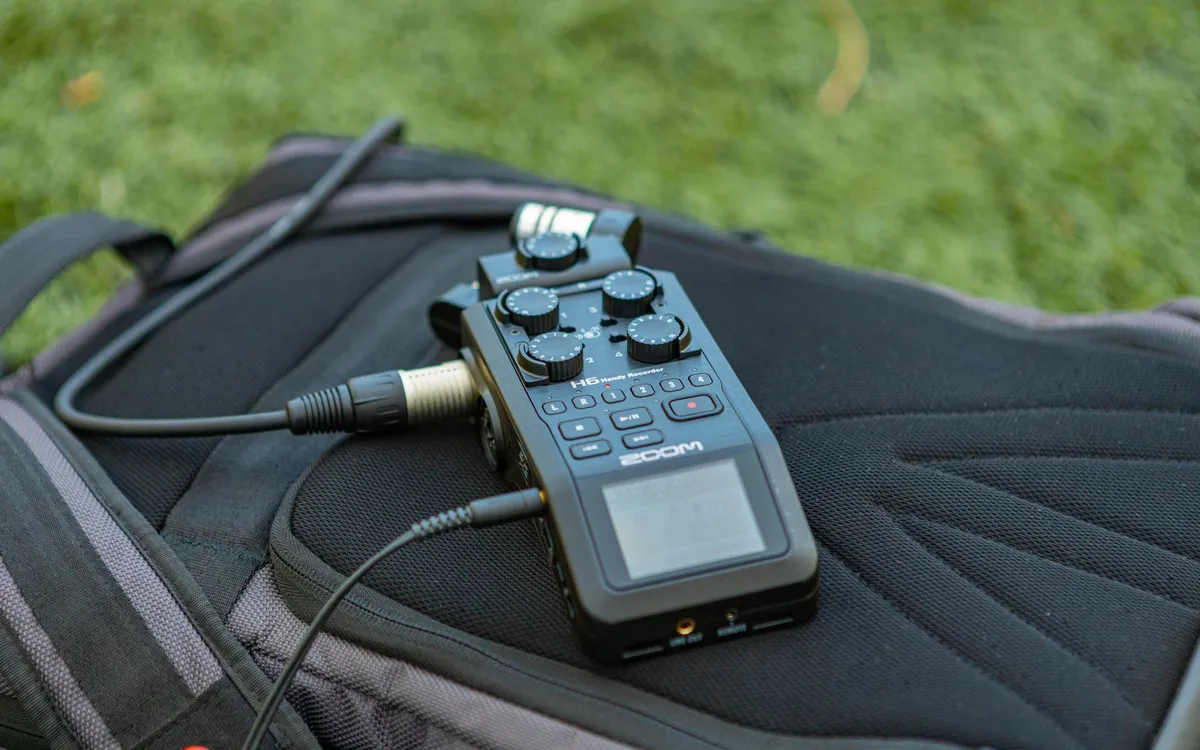
Most cameras will happily record audio, and most of them do it poorly — thin preamps, weak metering, mediocre converters, and inputs that hiss the moment you push the gain. A dedicated field recorder fixes all of that. It gives you clean preamps, real XLR inputs, proper headphone monitoring, and the ability to run several microphones at once. For documentary, where dialogue is the whole ballgame, it’s the difference between sound you fix in post and sound that’s broken before you start.
The other reason is redundancy. A recorder is a second pair of ears and a second set of inputs — a place to capture room tone, a wild interview, a backup track running alongside your wireless. When you’re shooting irreplaceable moments, you want belt and braces. Here’s what I’d buy at each level.
Zoom H4n Pro — the entry point everyone starts on
The H4n Pro is the recorder that taught a generation how to capture sound. Two XLR/TRS combo inputs, built-in X/Y stereo mics that are genuinely useful for ambience, and a price (around $220) that won’t scare anyone off. The preamps aren’t pristine — push them hard with a quiet source and you’ll hear some hiss — but for interviews with a decent mic close to the source, that rarely bites. It runs on AA batteries, fits in a jacket pocket, and just works. If you’re buying your first recorder, start here.
Zoom H6 — the four-input upgrade
The H6 (around $350) is the H4n’s bigger, more capable sibling and the recorder I’d point most documentary shooters toward. Four XLR inputs (six tracks total) means you can mic an interviewer, a subject, a lav, and a boom all at once. The preamps are noticeably cleaner than the H4n’s, the interchangeable mic capsules are clever, and the metering is clear. For multi-person scenes — round-table discussions, families, anything with more than one voice — this is the sweet spot.
Tascam DR-70D / DR-701D — built for cameras
Tascam’s DR-70D (around $200) is aimed squarely at the documentary and indie-film crowd: a flat, four-input recorder designed to mount under a camera or on a cage. Dual recording (a safety track 12dB lower, in case someone shouts) is a genuine lifesaver. The 701D adds better preamps and HDMI sync. If your workflow is camera-centric and you want sound and picture living on the same rig, Tascam built this for you.
Sound Devices MixPre series — the pro tier
When budget is no object and reliability is everything, Sound Devices is the name. The MixPre-3 and MixPre-6 (well over a thousand dollars) deliver preamps that are simply in another class — clean, quiet, with enormous headroom — plus 32-bit float recording on later models that makes clipping nearly impossible. Overkill for a one-person doc, essential for a funded production where the sound has to be flawless every single take.
Quick comparison
| Recorder | Inputs / tracks | Best for | Rough price |
|---|---|---|---|
| Zoom H4n Pro | 2 XLR / 4 | First recorder, interviews | ~$220 |
| Zoom H6 | 4 XLR / 6 | Multi-person scenes | ~$350 |
| Tascam DR-70D | 4 XLR / 4 | Camera-mounted rigs | ~$200 |
| Sound Devices MixPre-6 | 4 XLR / multi | Funded, broadcast-grade | $1,000+ |
How to choose
Count your microphones. If you’ll only ever record one or two voices, the H4n Pro is plenty and saves you money for glass or light. If you regularly shoot conversations, families, or panels, the extra inputs on the H6 or a Tascam pay off fast — running out of inputs mid-shoot is a miserable, unfixable situation.
Think about where the recorder lives. If you work solo and want everything on the camera, the flat Tascam bodies mount cleanly and keep your rig compact. If you’ll hand the recorder to a sound person or set it on a table, the Zooms are more comfortable to hold and operate.
And whatever you buy, learn to use dual-record (or 32-bit float, if you can afford it). Setting your levels with a safety track running 12dB lower means a sudden laugh or a raised voice won’t wreck the take. In documentary you don’t get a second take — the moment is the moment. That safety net has saved more interviews than any expensive preamp ever will. A recorder is also where the rest of the kit comes together; if you’re spec’ing a whole setup, see how I’d build a documentary kit under $2,000 around one.
The Best Audio Recorders for Documentary Sound
We test and recommend documentary gear independently. Buying through our partner links helps fund the magazine, at no extra cost to you.
Browse gear at B&HSome links on Indian Point Film are affiliate links: if you buy or subscribe through them we may earn a commission, at no extra cost to you. It never changes our recommendations.
Keep reading
The Best Cameras for Documentary Filmmaking
Forget the spec-sheet wars. Here's what a documentary camera actually needs to do, and the bodies that do it.
The Best Lavalier Microphones for Interviews on a Budget
Bad sound kills a documentary faster than bad pictures. Here are the lav mics that'll save your interviews without draining the budget.
The Best Budget Gimbals for Run-and-Gun Shooting
A gimbal turns shaky handheld into smooth, moving footage — if you pick the right one and don't fight it. Here's what to buy.